
Taiyaki: Japan’s fish-shaped cake and its fillings
Taiyaki is a Japanese fish-shaped cake made by cooking batter and a filling in a mould shaped like a sea bream. It is a snack sold throughout the year, often enjoyed warm, and its fish shape does not mean the filling contains fish.
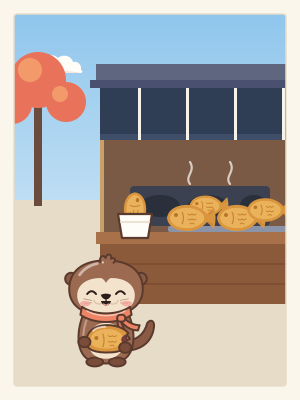
The fish is a shape, not the usual filling
The name joins tai, sea bream, with yaki, referring to cooking or grilling. The mould gives the outside a head, fins, scales and tail. Inside, sweet azuki-bean paste is a familiar filling; custard and other variations also exist. If a filling matters to you, ask the seller rather than relying on the fish outline.
To make a typical taiyaki, batter goes into the shaped mould with a portion of filling and is cooked until the cake holds together. A version with a thin shell can be crisp, while another feels thicker or softer. Freshness, batter and preparation all affect the result.
People have preferences about the shell, sweetness and filling. A friend might enjoy the contrast of a thin edge with a soft centre, or prefer custard to bean paste. Asking about texture gives you more to discuss than just whether a person likes “Japanese food”. There is no required way to take the first bite: head and tail make a playful preference question, not an etiquette test.
Korea’s bungeoppang is a useful comparison: it is also a fish-shaped filled snack, with a name referring to a crucian carp rather than sea bream. Shapes, batter and fillings vary between sellers. The moulds give the two snacks different outlines, while the particular batter and filling determine much of the eating experience. Compare a version you have tried with your friend’s favourite.
A warm snack without a single season
Taiyaki is sold throughout the year, though holding a warm cake can be particularly appealing in cold weather. Availability depends on the shop or stall.
A freshly cooked filling can be hotter than the outside suggests. Let it cool enough before taking a bite. If ingredients or allergies matter, ask about the specific batter and filling; a familiar name does not identify every variation.
For a pen pal, choose a real snack preference and compare it with theirs. If you already know bungeoppang, the Korean comfort food guide offers a way to describe a related snack.
Words for the mould and the filling
These readings use Japanese romanisation. The word anko names bean paste, while kasutaado names custard; those are more precise than guessing what is inside. Start your message with Japanese letter phrases.
| Term | Reading | Meaning |
|---|---|---|
| たい焼き | taiyaki | A sea-bream-shaped filled cake. |
| 鯛 | tai | Sea bream, the fish named by the cake’s shape. |
| あんこ | anko | Sweet bean paste; azuki paste is a familiar filling. |
| カスタード | kasutādo | Custard, another possible filling. |
| 生地 | kiji | The batter or dough forming the outside. |
Ask your pen pal
A food question works best with a detail about your own tastes. A Japanese pen pal might not eat taiyaki often, so leave room for another favourite snack.
- たい焼きを食べたことがありますか? — Have you ever eaten taiyaki?
- あんことカスタード、どちらが好きですか? — Do you prefer bean paste or custard?
- たい焼きは頭としっぽ、どちらから食べますか? — Do you start a taiyaki from the head or the tail?
- 外側はパリッとしたものと柔らかいもの、どちらが好きですか? — Do you prefer a crisp outside or a soft one?
- 寒い日に食べたくなるおやつはありますか? — Is there a snack you want to eat on cold days?
A postcard about a snack you would like to try
Describe the filling or texture you are curious about. Add the head-or-tail question for a little playfulness.
こんにちは! たい焼きは魚の形でも、中にはあんこなどが入っているのですね。私はカスタードが好きなので、その味を食べてみたいです。たい焼きは頭としっぽ、どちらから食べますか? 好きな温かいおやつも教えてください。
A culture postcard in Sea Pals
Crisp edges or a soft shell: tell a Sea Pals pen pal how you like your snacks. Write a taiyaki postcard and ask which filling they would choose.